
:::|
:::|
Tunghai University-News-- Tunghai University joins the University Social Responsibility Program of the Ministry of Education
Tunghai University has always stayed true to its founding core values. From implementing the 60-year student labor education and community service workshops, to contributing to social causes and social organizations, Tunghai University values not only the teaching of professional skills, but also the personal growth of students and faculty members on a Liberal Arts foundation.
“True Partners, True Community” is supervised by Dean Jeng Liu of the College of Social Sciences. It aims to foster humanities and social sciences education, citizenship education, fundamentals in humanities and social sciences, and multidisciplinary skills cultivation programs. It will focus on “agricultural renaissance,” “agricultural policies and practices,” and innovation-related courses in the fields of humanities. “Environmental monitoring and community service” is also a part of its planned actions. The program will investigate Taichung citizens’ understanding and awareness towards community farming, community economics, food safety, and air pollution while searching for collateral solutions. During its implementation, the team hopes to create a win-win outcome, which will mark a milestone for the university’s dedication to educational innovation and social responsibility .
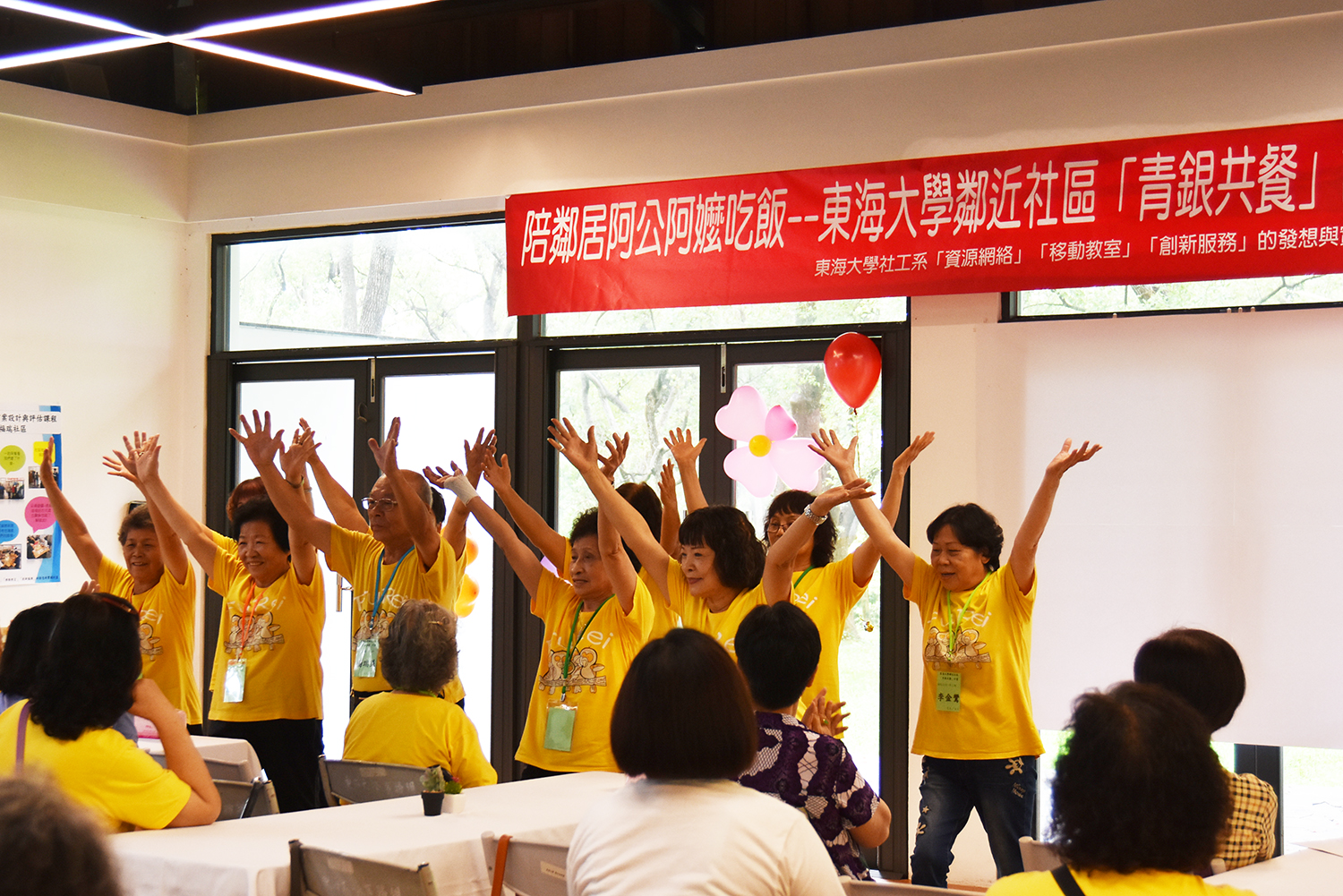
Tunghai University and nearby community senior citizens co-dining
Tunghai Vice President Chia-Chung Chan, meanwhile, leads the second program entitled “Co-Aging: The Establishment of a Senior Citizen Service Support System in Xitun District, Taichung City”. This program will reach out to and collaborate with service organizations under the A-B-C long-term care rating system in the Xitun District. Their potential partners include the Stella Matutina Social Welfare Foundation, the Taichung Veterans Hospital, the Cheng Ching Hospital, and C-rated long-term care stations. The main tasks include volunteer networks, talent cultivation, senior citizen-friendly space establishment, organizing relevant activities and projects, food-service systems, healthcare improvement, increasing the efficiency of care stations, and more. These goals will integrate with an innovative course system, community bonding system, and information platform system. By rallying participation and resources among teachers and students and aligning with government policies, a better and more complete community long-term care system will be established.
According to President Mao-Jiun Wang, ever since Tunghai’s establishment, this institution has devoted itself to addressing social causes and volunteer work. Recently, moreover, “social sustainability” has been designated as one of Tunghai’s strategic development objectives, especially regarding senior citizen service. In this respect, the nominated projects will focus on the real needs of society.
Vice President Chia-Chung Chan pointed out that the core purpose of both projects is to promote problem-based, multidisciplinary courses and innovative learning methods. The projects are both supported fully by the Tunghai board members and President Wang, and he hopes that the Xitun District will become a role model in the fields of long-term care.
The USR program run by the Ministry of Education emphasizes the social responsibility of universities and the importance of resource-sharing between schools and communities. The USR program has three categories: Seed Type (A), New Leaf Type (B), and Cultivation Type (C). Each participating school could only submit two applications, and Tunghai University’s applications were both accepted with one being classified as a New Leaf Type and one as a Cultivation Type, which is an impressive achievement.
Tunghai University joins the University Social Responsibility Program of the Ministry of Education
- Department : THUPR
- Category :
- View : 1503
- Date : 2017-09-02
Tunghai University has always stayed true to its founding core values. From implementing the 60-year student labor education and community service workshops, to contributing to social causes and social organizations, Tunghai University values not only the teaching of professional skills, but also the personal growth of students and faculty members on a Liberal Arts foundation.
“True Partners, True Community” is supervised by Dean Jeng Liu of the College of Social Sciences. It aims to foster humanities and social sciences education, citizenship education, fundamentals in humanities and social sciences, and multidisciplinary skills cultivation programs. It will focus on “agricultural renaissance,” “agricultural policies and practices,” and innovation-related courses in the fields of humanities. “Environmental monitoring and community service” is also a part of its planned actions. The program will investigate Taichung citizens’ understanding and awareness towards community farming, community economics, food safety, and air pollution while searching for collateral solutions. During its implementation, the team hopes to create a win-win outcome, which will mark a milestone for the university’s dedication to educational innovation and social responsibility .
Tunghai University and nearby community senior citizens co-dining
Tunghai Vice President Chia-Chung Chan, meanwhile, leads the second program entitled “Co-Aging: The Establishment of a Senior Citizen Service Support System in Xitun District, Taichung City”. This program will reach out to and collaborate with service organizations under the A-B-C long-term care rating system in the Xitun District. Their potential partners include the Stella Matutina Social Welfare Foundation, the Taichung Veterans Hospital, the Cheng Ching Hospital, and C-rated long-term care stations. The main tasks include volunteer networks, talent cultivation, senior citizen-friendly space establishment, organizing relevant activities and projects, food-service systems, healthcare improvement, increasing the efficiency of care stations, and more. These goals will integrate with an innovative course system, community bonding system, and information platform system. By rallying participation and resources among teachers and students and aligning with government policies, a better and more complete community long-term care system will be established.
According to President Mao-Jiun Wang, ever since Tunghai’s establishment, this institution has devoted itself to addressing social causes and volunteer work. Recently, moreover, “social sustainability” has been designated as one of Tunghai’s strategic development objectives, especially regarding senior citizen service. In this respect, the nominated projects will focus on the real needs of society.
Vice President Chia-Chung Chan pointed out that the core purpose of both projects is to promote problem-based, multidisciplinary courses and innovative learning methods. The projects are both supported fully by the Tunghai board members and President Wang, and he hopes that the Xitun District will become a role model in the fields of long-term care.
The USR program run by the Ministry of Education emphasizes the social responsibility of universities and the importance of resource-sharing between schools and communities. The USR program has three categories: Seed Type (A), New Leaf Type (B), and Cultivation Type (C). Each participating school could only submit two applications, and Tunghai University’s applications were both accepted with one being classified as a New Leaf Type and one as a Cultivation Type, which is an impressive achievement.
- previous Students of the Department of Food Science Interned in Japan
- MOU signed between the Taichung Economic Development Bureau and the Taiwan Social Enterprises Sustai.... next

