Views : 2291
The 2016 Ministry of Education Biomedical Innovation and Incubation Program executed by Tunghai University held its final presentation contest on November 26. Judges from the biomedical industry evaluated and selected three teams with the most market potentials and prospects as representatives of Tunghai to compete in the national competition. The three teams and their products are: Hermed with C-DAS (colorectal cancer drug), Racclean with Babetide (antibacterial peptides), and Modify with microplates for high throughput screening.
Professor Wei-Ting Chao of the Department of Life Science led the Hermed team to develop a new double-target antibody drug for colorectal cancer, collaborating with Development Center for Biotechnology (DCB). Besides treating transferrable colorectal cancer, it could also be integrated with personalized diagnosis medication in the future.

Tunghai University Biomedical Lab works closely with the medical industry in R&D
Professor Feng-Di Lung of the Department of Chemistry and Professor Yesong Gu of the Department of Chemicals and Materials Engineering co-led two teams. Through multi-disciplinary integration on campus, the Racclean team developed an anti-bacterial product for babies, providing a safer and cleaner environment. In the future, the team would also devote much effort on the research and development for antimicrobial peptides. On the other hand, the Modify team developed the covalent-bound modified microplates that would improve the traditional way peptides or proteins attaches to the microplates, shortening the time for testing and demonstrating better reproducibility and flexibility. In the future, this technology would be used for oral cancer screening.
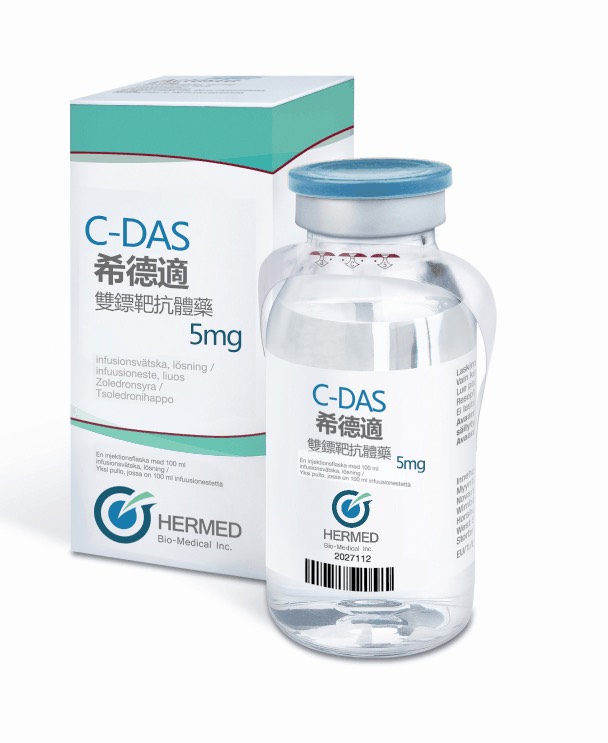
Prototype of Hermed’s double-target antibody drug for colorectal cancer
This year marks the third year Tunghai University executes the Biomedical Innovation and Incubation Program funded by the Ministry of Education. The program has been supervised by Professor Gu and co-supervised by Professor Lung. In three years, the program has cultivated many biotechnology talents and won many prizes. This year, each team’s R&D capability is even more mature. The selected teams all have high-end biotechnology products with prototypes, showing that Tunghai’s medical and biotechnological strengths have already reached industrial development standards.

Product image posters for the national competition; from left to right are Hermed, Racclean, and Modify
According to Professor Chao, the teams have gained advantages in multidisciplinary collaboration. Thanks to the professional consultancy from the Department of Chemistry, Department of Business Administration, and Innovation Incubation Center, each team’s professional skills, business models, and financial plans are closer to maturity. He is optimistic that Tunghai team will be winning again in the national competition.
.jpg)
Professor Wei-Ting Chao of the Department of Life Science led the Hermed team to develop a new double-target antibody drug for colorectal cancer, collaborating with Development Center for Biotechnology (DCB). Besides treating transferrable colorectal cancer, it could also be integrated with personalized diagnosis medication in the future.
Tunghai University Biomedical Lab works closely with the medical industry in R&D
Professor Feng-Di Lung of the Department of Chemistry and Professor Yesong Gu of the Department of Chemicals and Materials Engineering co-led two teams. Through multi-disciplinary integration on campus, the Racclean team developed an anti-bacterial product for babies, providing a safer and cleaner environment. In the future, the team would also devote much effort on the research and development for antimicrobial peptides. On the other hand, the Modify team developed the covalent-bound modified microplates that would improve the traditional way peptides or proteins attaches to the microplates, shortening the time for testing and demonstrating better reproducibility and flexibility. In the future, this technology would be used for oral cancer screening.
Prototype of Hermed’s double-target antibody drug for colorectal cancer
This year marks the third year Tunghai University executes the Biomedical Innovation and Incubation Program funded by the Ministry of Education. The program has been supervised by Professor Gu and co-supervised by Professor Lung. In three years, the program has cultivated many biotechnology talents and won many prizes. This year, each team’s R&D capability is even more mature. The selected teams all have high-end biotechnology products with prototypes, showing that Tunghai’s medical and biotechnological strengths have already reached industrial development standards.
Product image posters for the national competition; from left to right are Hermed, Racclean, and Modify
According to Professor Chao, the teams have gained advantages in multidisciplinary collaboration. Thanks to the professional consultancy from the Department of Chemistry, Department of Business Administration, and Innovation Incubation Center, each team’s professional skills, business models, and financial plans are closer to maturity. He is optimistic that Tunghai team will be winning again in the national competition.